
Most people choose a repair shop from a sign on a main road, a neighbour’s shrug, or the first result that looks open. None of those tells you what happens after the lid comes off. The useful test is smaller. Can the person in the room say what is wrong, in words you follow, before any money changes hands?
A laptop is awkward to judge from the outside. A dark picture, a pack that fades, a row of silent keys, and a machine that has grown heavy can look alike from the chair. Two counters can use the same words and still do different work. The difference shows up in the answers you get while the machine is still yours to take home.
Start with the room, not the slogan
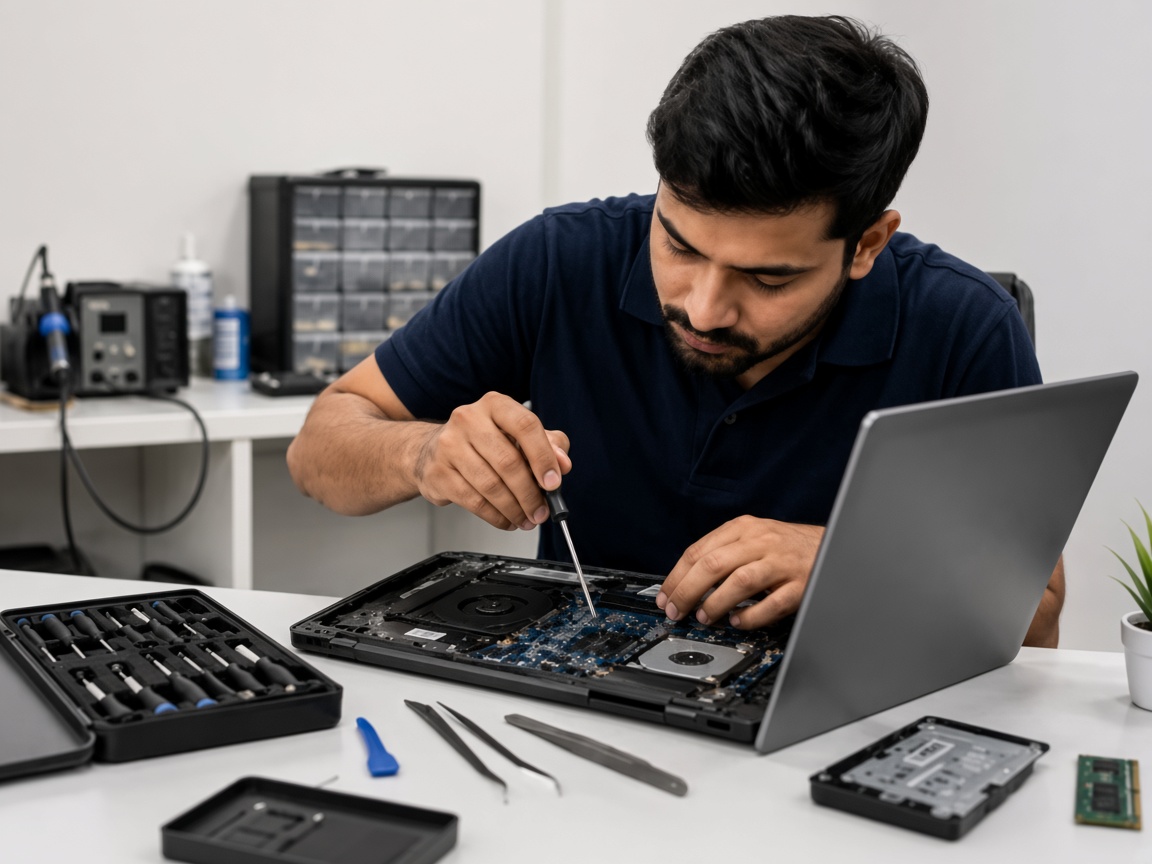
Ask where the laptop will be opened. A straight answer is a room you can point at, on a road you can find, with one counter. A vague answer is a van, a friend, or “we will see.” You want the first kind. The look and the fitting should happen in that same room, so the person who describes the fault is the person who would change the part.
SAI Laptop Service keeps that look at one walk-in counter in Ganesh Complex, Electronic City. Neighbours carry the machine in. There is no second bench in the lanes around it, and the shop does not send a rider to a flat or an office. If a shop cannot tell you the building, keep looking.
Ask them to name the fault while you are still there
Handing a laptop across a counter and collecting it days later, with a line on a bill you do not recognise, is a poor way to choose. A better counter lets you stay for the first look, or at least tells you the finding in plain speech before the work begins. “The panel is cracked” is a finding. “We will check and update you” is a delay. Both can be honest, but only the first one lets you decide.
Describe what you saw, not a part you guessed. A picture that went dark after the lid was shut is more useful than a model code you dug out of a sticker. A drink on the deck, a drop from a desk, a shutdown during a call, and a slowdown that took a month are different stories. Put them in the order you noticed them. Several faults can sit on one quote, but only if you have named each of them.
A quote you are allowed to refuse
Do not agree to paid work until you have heard the fault and, if a part is needed, the name of that part. No charge is printed on this page. The number you need is the one spoken for your machine, after someone has looked, and you may walk away from it. A shop that will not let you walk away is asking for trust it has not earned yet.
If the name of the part surprises you, pause. A dark picture with the fans still moving can be the panel, the ribbon, or the board. A laptop that stays off can be a pack that will not take a charge, an adapter that no longer feeds it, or a board. Those are separated by a look, not by the story you told on the way in. Ask which one they found. If they cannot say, the quote is not ready.
What a clear answer sounds like
A clear answer ties the symptom to one job. Cracked glass, a picture that flickers, a picture so dim you tilt the lid toward a window, and a black panel on a laptop that still seems awake are display jobs when the display is the fault. A pack that swells, fades before evening, or will not take power is a battery job when the battery is the fault. A key that doubles, a key that says nothing, a missing character, or a spill across the deck can mean the keyboard itself. A disk that hesitates, ticks, or gives up can be exchanged for an SSD or for a different hard disk. Pop-up windows and a machine that slowed across a few weeks are a malware clean, which is not a new disk. Fans that roar, heat through the palm rest, and a shutdown in the middle of a call are followed to the fan and the heat sink.
Notice what the answer does not do. It does not fold four faults into one vague “service.” It does not treat a clean install of Windows as a substitute for a keyboard or a pack. It does not promise that files on an old disk will be waiting on a new one. If those files matter, say so before the bottom cover comes off. A shop that shrugs at that question is a shop to leave.
Leave the case closed on the way there
Choosing well also means not creating a second fault before you arrive. Keep the screen, the keys, and the pack inside the case. Lifting them on a table at home snaps clips and tears ribbons, and those breaks sit on top of the problem you noticed. If the glass is already cracked, keep the broken layer where it is. Do not lift that layer, and do not poke the crack to see it run. If the palm rest has risen, or the base rocks on a table, stop. Do not clamp the cover, and do not pierce the pack. Pull the adapter out and keep the laptop flat while you carry it.
Bring the adapter if it is still at home, and bring the sign-in password, so a test after the work is not stuck on a lock screen. You do not need to dismantle anything to find a long model string. The name on the lid is enough to start the conversation.
The name on the lid
The lids already opened on this bench read Dell, HP, Lenovo, Acer, ASUS, Apple, and MSI. That is the daily work. It is not a badge issued by the company that printed the name. When you call, read that name aloud, and mention the rough age if you know it. A shop that asks those two things is preparing for your machine. A shop that only asks for a payment link is not.
The board on the wall shows the parts this counter fits when they are the fault: charger, battery, drive, memory, keyboard, and motherboard. A stick of memory that freezes the picture is named the same way, after someone has looked. Ask for the name before you agree. If you wanted a different approach, say so before the cover goes back on.
The same laptop should go home
A repair visit ends with the machine you arrived with. It should not become a pitch for a different laptop, and it should not end with your files on a machine you did not bring. When the work is finished, you leave with that same laptop. If a shop talks about swapping it before anyone has named the fault, that is a sales conversation, not a repair.
You can also judge a counter by what it refuses to invent. It should not invent a time for a job it has not seen. It should not invent a part before the look. It should not invent a promise about files. The honest sentence is the short one: this is the fault, this is the part if a part is needed, and this is the quote. You decide after that sentence, not before it.
Where to stand when you have decided
This counter is at NO 35/1, NO 26, Ganesh Complex, Above TVS Showroom Main Road, Hosur Rd, opp. to Infosys Limited, Electronic City, Bengaluru, Karnataka 560100. You walk in with the laptop. Whoever lifts the cover should be the one who tells you the fault. That talk happens before any paid work, in that room.
Call or WhatsApp 099724 47766 and describe, in everyday language, what the laptop is doing. Ask where it will be opened, which fault they can already suspect, and for the quote before you agree to anything paid. The list of work for this same counter is on the services page. Other notes here go into what you can check at a desk before you carry the laptop in, into what to leave untouched on the way, and into why the diagnosis stays in one shop.